Intrusion Detection Systems (IDS)
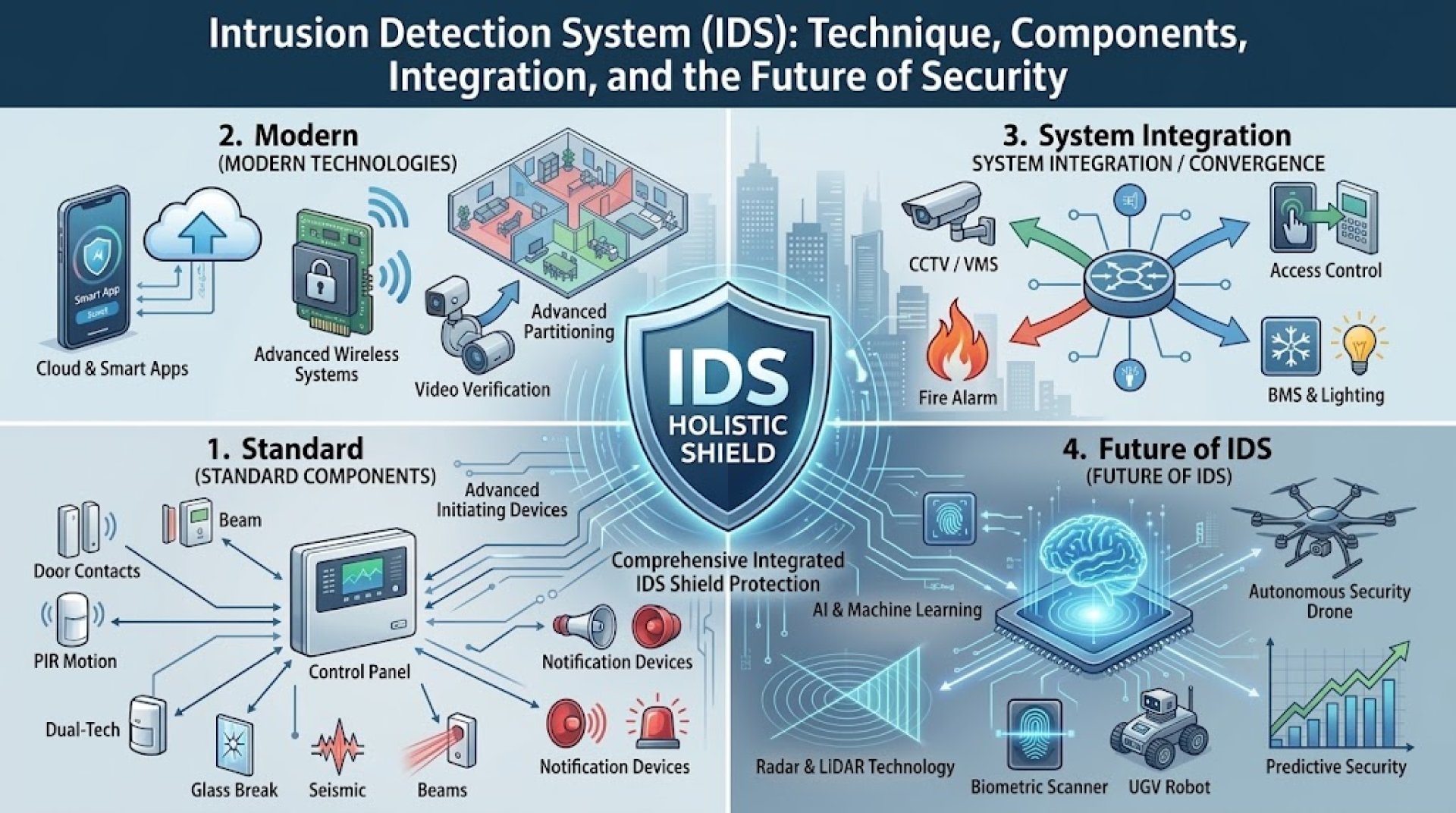
Technical Article: An In-Depth Look at Intrusion Detection Systems (IDS) – Technologies, Standard Components, Integration, and the Future of Security
In an era where physical risks and threats are becoming increasingly complex, relying solely on security guards or CCTV cameras is no longer sufficient to protect critical assets, sensitive data, and human lives within a facility. The Intrusion Detection System (IDS) has stepped up as the core foundation for creating an effective physical security "shield." This system no longer merely sounds an alarm when a door is pried open; it has evolved into a smart network capable of analyzing, detecting, verifying events, and seamlessly integrating with other building infrastructure systems.
This article delves into the core components of an IDS, the essential standard equipment, the technologies that modern buildings should adopt, system integration (convergence), and the future technological trends that will revolutionize the security industry.
1.Core Components and Standard Equipment of an IDS
A standardized and highly reliable intrusion detection system consists of hardware components that work in continuous synchronization 24/7. These core components can be categorized as follows:1.1 Control Panel
Acting as the brain of the system, the control panel receives signals from all sensors, processes statuses (e.g., tampering or motion detection), and sends commands to notification devices or central monitoring stations. A standard control panel must feature:
- Battery Backup: Must be capable of continuous operation for at least 12-24 hours during a power outage.
- Tamper Switch: If an unauthorized attempt is made to open the panel or cut its wires, the system must trigger an immediate alarm, even if the system is in a "Disarmed" state.
- Zoning: The ability to divide the detection area into specific zones to pinpoint the exact location of an intrusion.
1.2 Sensors & Detectors
Selecting the right sensors for specific environments is the key to minimizing False Alarms.
- Magnetic Contacts / Reed Switches: Used to detect the opening and closing of doors and windows using magnetic fields. If the two magnetic pieces are separated beyond a specified distance, the circuit opens and triggers an alarm. They are available in surface-mount and flush-mount options.
- Passive Infrared Sensors (PIR): Detect changes in infrared radiation or body heat contrasting with the background temperature. Standard models should include a "Pet-Immunity" function to ignore animals below a certain weight threshold.
- Dual-Technology Motion Detectors: Combine PIR and Microwave technologies. The system only triggers an alarm when both heat signatures (PIR) and reflected microwave signals detect movement simultaneously. This is ideal for areas with sudden temperature changes or drafts, practically eliminating false alarms.
- Glass Break Detectors: Utilize high-frequency microphones tuned to analyze the specific acoustic patterns of breaking glass (requiring a low-frequency "thud" followed by a high-frequency "shatter").
- Seismic/Vibration Sensors: Installed on walls, safes, or ATMs to detect vibrations caused by drilling, smashing, or explosions.
- Active Infrared Photoelectric Beams: Used for perimeter protection by transmitting infrared beams between a transmitter and a receiver. If an intruder breaks the beam, the alarm is instantly triggered.
1.3 Notification Devices
Siren & Strobe Light: Designed to induce panic and deter intruders. Exterior sirens should output at least 100-110 decibels and include strobe lights to help security personnel or police rapidly identify the location of the breach.
1.4 User Interfaces & Communication
- Keypad: Used for entering PIN codes and arming/disarming the system. Modern systems favor touchscreens or RFID/keycard readers for speed and convenience.
- Communication Modules: Responsible for transmitting data externally. The current standard mandates dual-path communication, typically utilizing a LAN (IP/Ethernet) connection as the primary route and a 4G/LTE cellular module as a failover if the building's internet goes down.
2. Modern Technologies for Contemporary Buildings
Designing a security system for modern facilities—whether corporate offices, factories, or high-end residential properties—requires the application of the following advanced technologies for maximum efficiency:
2.1 Advanced Wireless Systems Historically, wireless systems were viewed as unstable and vulnerable to signal jamming. However, modern Security-Grade Wireless technologies have advanced significantly. Contemporary buildings should deploy systems featuring two-way communication, high-level encryption (such as AES-128 or AES-256, similar to banking transactions), and Frequency Hopping technology, which automatically switches radio channels if interference is detected. Furthermore, modern wireless sensor batteries can last between 3 to 7 years, drastically reducing maintenance overhead.
2.2 Cloud-based Management & Smart Apps Facility managers no longer need to stand in front of a physical control panel. Modern systems must offer cloud connectivity, allowing users or facility managers to arm/disarm the system, check individual sensor statuses, and receive push notifications via smartphone apps from anywhere in the world. This includes Geofencing capabilities, which can automatically prompt the last manager leaving a designated radius to arm the system.
2.3 Video Verification One of the largest pain points for intrusion systems is the "False Alarm," which wastes time and security resources. Current technology solves this with PIR sensors equipped with built-in cameras. Upon detecting a breach, the sensor captures a burst of images or a short video clip (5-10 seconds) and instantly sends it to the user's app or the central monitoring station. This allows for visual verification—confirming whether it is a genuine intrusion or just a stray animal/forgetful employee—before dispatching the police.
2.4 Advanced Partitioning For large buildings or industrial plants, the installed system must support independent partitioning. For instance, the system can automatically arm the office zone at 7:00 PM, while the warehouse zone, operating on a night shift, remains disarmed. User permissions can also be strictly configured to grant access or control only to specific partitions.
3. System Integration & Convergence
The true value of a modern security system lies in interoperability—its ability to communicate and execute commands across different platforms. Integrating the IDS with other building systems elevates security to a holistic level:
3.1 Access Control System Integration These two systems should function in perfect harmony. Examples include:
Auto-Disarm: When an executive swipes a card or scans a fingerprint at the main entrance, the Access Control system verifies the credential and automatically sends a command to the IDS to disarm that specific office zone, eliminating the need to manually enter a PIN at a keypad.
High-Security Lockdown: If sensors detect broken glass or an after-hours breach, the IDS can trigger the Access Control system to instantly lock all doors leading to critical areas like server rooms or document vaults, effectively containing or delaying the intruder.
3.2 CCTV / VMS Integration When an IDS is integrated with a Video Management System (VMS):
PTZ Auto-Tracking: The moment a perimeter motion sensor is triggered, the system commands Pan-Tilt-Zoom (PTZ) cameras to immediately snap to the specific preset coordinates of that sensor, recording the event at maximum resolution.
Pop-up Alerts: In the security control room, the live video feed from the breached area instantly pops up in full screen with red alert borders, ensuring operators do not miss the event.
3.3 Building Management System (BMS) and Lighting Integration
Smart Lighting Deterrence: During a nighttime breach, the IDS can send commands via network protocols to the lighting control system, immediately turning on all lights in the compromised zone to 100% brightness. This not only startles and deters the intruder but also ensures CCTV cameras capture clear, full-color facial details.
HVAC Control: If an intrusion occurs in a highly restricted area (e.g., a laboratory), the system can shut down the HVAC to prevent the unauthorized distribution of airborne toxins through the building's ventilation.
3.4 Fire Alarm System Integration While these systems serve different primary functions, they must coordinate flawlessly during emergencies. In the event of a fire, the Fire Alarm System must have absolute override authority over all security systems. All access-controlled doors must unlock automatically (Fail-Safe mode) for evacuation. The IDS may automatically lower its siren volume to ensure Voice Evacuation announcements are heard clearly, while still meticulously logging all door activities to detect any opportunistic theft during the chaos.
4. The Future of Intrusion Detection Technology
The security industry is rapidly entering an era of deep analytics and total automation. Technologies poised to reshape the landscape in the near future include:
4.1 AI & Machine Learning (Edge AI) Future intrusion sensors will feature built-in Edge AI processors. Instead of merely detecting "motion," the system will perform Object Classification—distinguishing between humans, animals, weather elements, or vehicle headlights—effectively driving false alarms down to zero. Additionally, Machine Learning will enable Behavioral Analytics. The system will learn the building's normal patterns (e.g., cleaning staff arriving between 8:00 PM and 10:00 PM). If someone enters at 3:00 AM, the system will flag it as a High Threat Level anomaly and alert authorities instantly.
4.2 Radar & LiDAR Technology The limitation of PIR sensors is their inability to "see" through obstacles and their vulnerability to extreme weather. mmWave Radar and LiDAR technologies will replace them in high-security perimeters. These technologies generate 3D Point Clouds, accurately detecting the distance, size, speed, and direction of an intruder, regardless of camouflage, thermal shielding, or heavy fog. The system will be able to plot the intruder’s real-time movement trajectory onto a digital building map.
4.3 Advanced Biometric Authentication PIN codes will eventually become obsolete. Systems will transition entirely to Frictionless Authentication, utilizing facial recognition at control panels or even Gait Analysis through CCTV cameras to verify identities without stopping. If the system detects an unrecognized biological profile or walking pattern, it can quietly initiate a surveillance mode or trigger a Silent Alarm.
4.4 Autonomous Security Drones & Robotics When a perimeter beam detects a breach, instead of sending a human guard into the dark, the IDS will interface with automated drone systems. An Autonomous Security Drone will deploy instantly, flying directly to the triggered GPS coordinates to illuminate the area with spotlights and stream live video back to the command center. Meanwhile, Unmanned Ground Vehicles (UGVs) could be deployed inside industrial facilities to physically block escape routes.
4.5 Predictive Security Future IDS networks will shift from reactive to proactive stances. Utilizing Big Data and Threat Intelligence, systems will analyze local crime statistics, social media intelligence, or environmental factors. If the system calculates a high-risk scenario (e.g., civil unrest within a 5-mile radius or a holiday weekend historically prone to burglaries), it will autonomously maximize sensor sensitivity across the board and preemptively engage secondary locking mechanisms.
Conclusion
Intrusion Detection Systems have evolved far beyond simple alarm bells. Driven by cutting-edge standard equipment, wireless and cloud technologies, and the capacity for deep cross-platform integration with Access Control, CCTV, and Fire Alarms, the IDS has become the central nervous system of holistic facility security. For building owners and system integrators, investing in adaptable, future-proof systems capable of embracing AI and IoT is not just a technological upgrade—it is a strategic investment that guarantees a flawless, long-term security posture to protect both human life and invaluable assets.
