Access Control Systems (ACS)
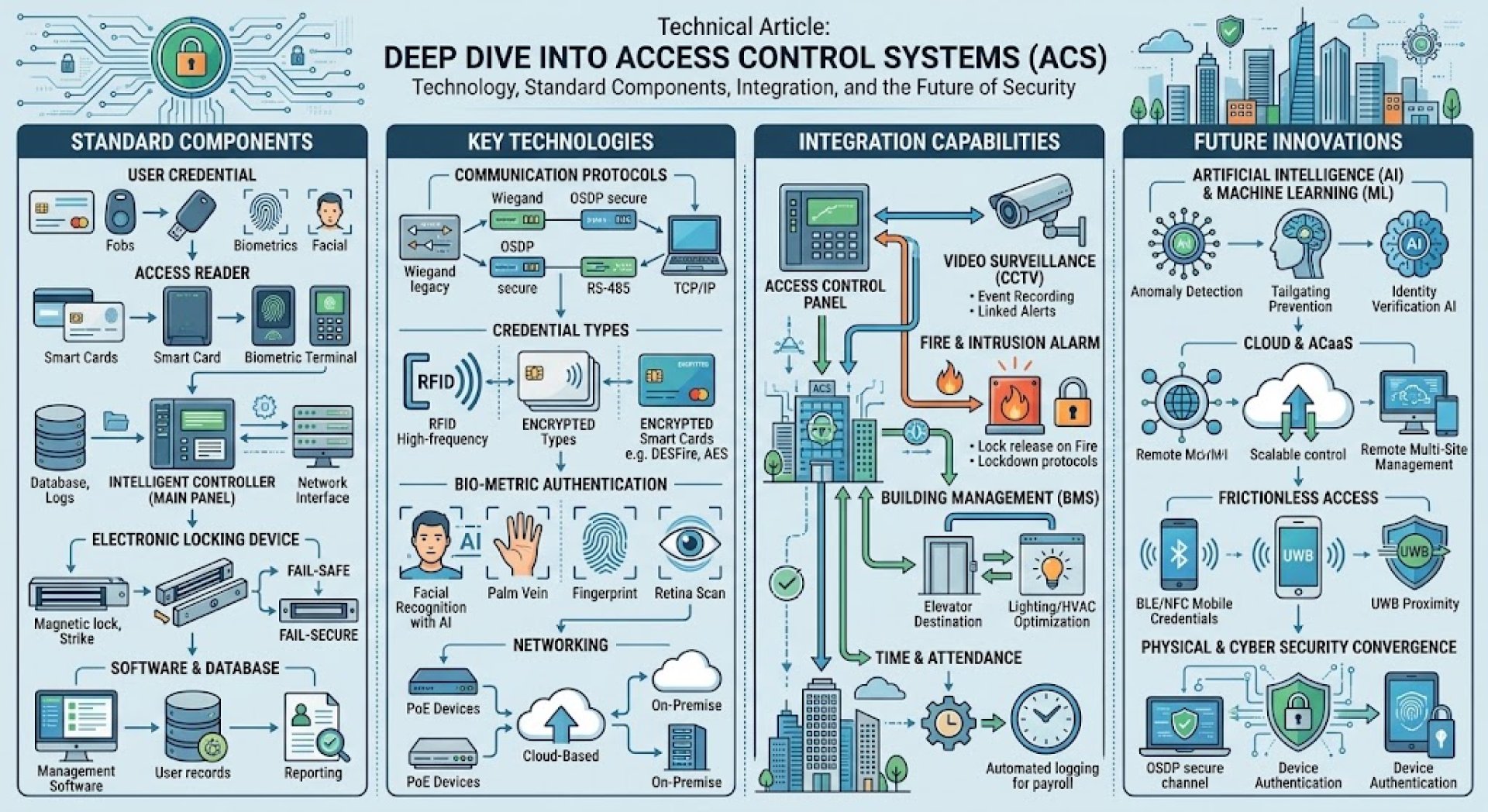
Technical Article: Deep Dive into Access Control Systems (ACS) – Technology, Standard Components, Integration, and the Future of Physical Security
In the digital age, where safeguarding data and physical assets is of paramount importance, facility management has moved far beyond traditional mechanical keys. The Access Control System (ACS) has become a fundamental infrastructure pillar for modern buildings, including corporate offices, industrial plants, hospitals, and high-end residential complexes. Acting as an intelligent, 24/7 guardian, the ACS meticulously filters, authorizes, tracks, and records every individual's movement across designated zones.
This article explores the architecture of Access Control Systems, the mandatory standard equipment, modern technologies required for contemporary facilities, system convergence (integration) with other security platforms, and the future innovations poised to revolutionize spatial management.
1. Architecture and Standard Components of an Access Control System
A robust and reliable Access Control System relies on a distributed architecture. This ensures that even if the primary network or central server fails, the local hardware continues to function securely. The core hardware components include:
1.1 Access Controllers (The Brain) The controller board is the central processing unit of the local system. It stores the user database, access rights, and time schedules, making the definitive decision to unlock a door based on data received from the readers.
Edge Controllers vs. Centralized Controllers: Modern architectures favor IP-based Edge Controllers installed near the door. These connect directly to the Local Area Network (LAN), reducing cabling costs and increasing stability. In the event of a server outage, edge controllers utilize offline decision-making to maintain standard operations.
Advanced Capabilities: Standard controllers must support Anti-Passback (preventing a card from being passed back to another person), Interlock/Mantrap configurations (requiring the first door to close completely before the second can open, ideal for cleanrooms or data centers), and feature dedicated battery backups.
1.2 Readers and Credentials These devices capture user data and transmit it to the controller for evaluation.
RFID Readers: Card technology varies significantly in security. Legacy Proximity (125 kHz) cards are easily cloned and obsolete for secure environments. The current standard mandates high-frequency (13.56 MHz) smart cards, specifically MIFARE DESFire EV2/EV3. These utilize advanced AES encryption, making cloning virtually impossible.
Biometric Scanners: While fingerprint scanning remains a foundational standard, heightened security and hygiene demands have popularized touchless biometrics. Facial recognition, iris scanners, and palm vein scanners offer superior security, as they are exceptionally difficult to forge or bypass.
1.3 Electronic Locking Hardware The selection of electronic locks depends heavily on door types and strict life-safety/fire codes.
Electromagnetic Locks (Maglocks): Utilizing an electromagnetic field (typically 600 lbs or 1200 lbs holding force), these are commonly used on glass or aluminum swing doors. They strictly operate in a Fail-Safe mode (unlocking automatically when power is removed), which is a legal requirement for designated fire escape routes.
Electric Drop Bolts: Featuring a metal deadbolt that drops into a strike plate, these are ideal for double-swing frameless glass doors. They can be configured as either Fail-Safe or Fail-Secure.
Electric Strikes: Installed in the door frame to work in conjunction with existing mechanical locksets, these generally operate in a Fail-Secure mode (remaining locked during a power outage). They are suited for high-security rooms that are not primary evacuation routes, such as server rooms.
1.4 Egress Devices (Exit Hardware)
Push to Exit Buttons: Used to manually break the power circuit to a Maglock. Modern facilities increasingly use No-Touch Sensors (infrared proximity sensors) to trigger the exit without physical contact.
Request to Exit (REX) Motion Sensors: Installed above the door on the secure side. When a person approaches, the sensor automatically signals the controller to unlock the door, allowing for seamless egress.
Emergency Break Glass: A mechanical override device. In emergencies or total system failures, breaking the glass physically cuts power to the door locks, ensuring immediate evacuation.
1.5 Access Control Management Software Installed on a central server or cloud platform, this software aggregates data from all network controllers. It provides a centralized interface for adding or removing users, defining Access Levels, generating Time & Attendance reports, and monitoring real-time door statuses overlaying interactive facility floor plans.
2. Modern Technologies for Contemporary Buildings
Modern building architecture demands access systems that are flexible, highly secure, and optimized for User Experience (UX). The following technologies represent the current industry benchmark:
2.1 Transitioning from Wiegand to OSDP (Open Supervised Device Protocol) Historically, readers communicated with controllers via the Wiegand protocol—an unencrypted, legacy format highly susceptible to wire-sniffing and credential cloning. Contemporary security specifications mandate OSDP (Secure Channel). OSDP utilizes two-way, AES-128 bit encryption and continuously monitors the online/offline status of readers, instantly alerting administrators to any tampering, wire-cutting, or unauthorized device swapping.
2.2 Mobile Access Credentials Smartphones have become the definitive digital key. Mobile Access technology leverages Bluetooth Low Energy (BLE) or Near Field Communication (NFC). Users simply present their phones near the reader to gain entry. This eliminates the recurring cost of physical plastic cards, mitigates the risk of lost credentials, and allows administrators to issue virtual credentials Over-The-Air (OTA) to new employees or VIP guests instantly.
2.3 Access Control as a Service (ACaaS) The industry has aggressively shifted toward cloud-based architectures. ACaaS allows Facility Managers to securely log into the system via web browsers or mobile apps from anywhere in the world. They can perform emergency lockdowns, audit logs, or amend user privileges remotely. Crucially, ACaaS offloads server maintenance and automates cybersecurity patches, shifting the IT burden to the cloud provider.
2.4 Touchless Advanced Biometrics In the wake of global health concerns, facial recognition technology has evolved exponentially. Modern algorithms accurately authenticate individuals in low light, with changes in hairstyle, or while wearing face masks. The critical feature of modern systems is Liveness Detection (Anti-Spoofing)—AI algorithms that analyze facial depth and micro-movements to reject photographs, videos, or 3D masks presented by intruders.
3. System Integration and Convergence
An Access Control System achieves maximum efficacy when it breaks out of its silo and integrates seamlessly with other building infrastructure platforms, creating a holistic, responsive security ecosystem:
3.1 Fire Alarm System Integration This is a non-negotiable life-safety integration. When the Fire Alarm System detects a fire, a hardwired signal must trigger the ACS to immediately cut power to all Fail-Safe locks along the evacuation routes. This ensures that doors unlock automatically, allowing occupants to evacuate without needing to present credentials or interact with exit buttons during a panic situation.
3.2 CCTV and VMS Integration Fusing ACS with a Video Management System (VMS) enables Video Verification. If the ACS detects an "Access Denied" event or a "Door Forced Open" alarm, it triggers the VMS to instantly pop up the associated camera feed on the security operations screen. The system bookmarks the video footage with the exact timestamp and credential data, allowing for rapid investigation and suspect identification.
3.3 Intrusion Detection System Integration These systems can coordinate fluidly to eliminate human error. For example, when the first authorized manager badges into the office in the morning, the ACS communicates with the Intrusion Panel to automatically Disarm the security zones. Conversely, when the last employee badges out and confirms departure, the system can automatically Arm the perimeter, ensuring the facility is never left unprotected due to forgotten PIN codes.
3.4 Building Management Systems (BMS) and Elevator Destination Dispatch
Smart Building Convergence: When an employee passes through the lobby turnstiles, the ACS sends occupancy data to the BMS. The BMS can then autonomously turn on the lights and adjust the HVAC settings specifically for the floor or zone where that employee works, drastically reducing energy waste.
Destination Dispatch Elevators: Upon swiping a badge at the turnstile, the system immediately directs the user to a specific elevator car (e.g., "Proceed to Car B"). The elevator autonomously delivers the user directly to their authorized floor without requiring them to press any buttons inside the cab, improving traffic flow and reinforcing vertical security.
3.5 Visitor Management Systems (VMS) Modern facilities have replaced physical logbooks and ID exchanges with smartphone-based pre-registration. Visitors receive a secure QR code via email prior to arrival. They scan this code at lobby readers or turnstiles to gain access. These QR codes are governed by strict parameters—granting access only to specific meeting room zones and expiring automatically after a predefined time limit.
4. The Future of Access Control Technology
The physical security industry is rapidly advancing toward autonomous, frictionless, and predictive operations. The innovations poised to dominate the near future include:
4.1 Frictionless Access via Ultra-Wideband (UWB) While BLE and NFC require users to present their phones to a reader, Ultra-Wideband (UWB) technology delivers a truly frictionless experience. UWB possesses centimeter-level spatial awareness. As an authorized user walks toward a door within a 1-to-2-meter radius, the reader detects the precise location, trajectory, and digital credential of the smartphone inside their pocket or bag. The door unlocks automatically as they approach, requiring absolutely no physical interaction or pausing.
4.2 AI and Anomaly Detection Artificial Intelligence will shift ACS management from reactive auditing to proactive threat hunting. Machine Learning algorithms will establish behavioral baselines for every employee. If an employee who strictly works from 9:00 AM to 5:00 PM at the main entrance suddenly attempts to badge into the server room at 3:00 AM, the AI will flag this as a critical anomaly. It can temporarily suspend the credential and alert security. Additionally, AI video analytics paired with door sensors will definitively identify Tailgating—counting the number of physical bodies passing through a door versus the number of authorized badge swipes, instantly alerting guards to unauthorized piggybacking.
4.3 Decentralized Identity and Blockchain Managing redundant employee databases across massive global enterprises poses a significant cybersecurity risk. Blockchain technology will introduce Decentralized Identity. Employees will own their encrypted digital identity on a secure blockchain. When accessing a regional office or a foreign branch, the local system will verify their access rights via a Smart Contract without transferring or storing sensitive biometric or personal data on local servers. This drastically mitigates the risk of centralized data breaches.
4.4 Zero Trust Physical Security The cybersecurity paradigm of "Zero Trust" (never trust, always verify) is migrating to physical security. Systems will no longer grant access based solely on the presentation of a valid credential. Instead, they will evaluate Contextual Risk. For instance, if an employee’s badge is swiped on the 10th floor, but the organization’s mobile app geolocation shows the employee's smartphone is currently at a coffee shop downtown, the system will recognize a stolen credential scenario. It will issue an "Access Denied" command and prompt a secondary biometric challenge to resolve the conflict.
The Access Control System has evolved from a mechanism for keeping doors locked into a sophisticated, data-driven identity management platform. By implementing robust standard hardware, embracing OSDP protocols and cloud architectures, and executing deep integrations with Fire, CCTV, and BMS platforms, facilities are transformed into true Smart Buildings. For organizations and system integrators, investing in scalable, AI-ready, and UWB-capable access control infrastructure is a strategic necessity that guarantees long-term operational efficiency, supreme user convenience, and the absolute protection of human lives and critical assets.
